Here is this week’s segment on how to streamline your morning routine with your children.
Sound Off: What are your tips for creating a smooth morning with your kids?
Here is this week’s segment on how to streamline your morning routine with your children.
Sound Off: What are your tips for creating a smooth morning with your kids?

I know you guys were most impressed with the way we organized our closet, but what you *REALLY* wanted to know is how do we organize our pantry.
Remember when I revamped my laundry system and my yard sale system? That day I hit up the same college student for a great bookcase that she was getting rid of for only $20! I knew right away what I wanted to do with it and couldn’t wait to bring it home and put it in our basement.
First, let me give you some background information on our house and previous storage solutions. My kitchen does not have very many cupboards or pantry space so I have had to be more creative with my storage. Our big dream is to expand my tiny utility closet into a walk-in pantry, but until that happens I have been storing the majority of my pantry items in our basement.
Previously, we had a dark wood bookcase that was extremely deep that we were using to store the pantry items. We had ripped this “bookcase” out of our closet that we had turned into an entertainment unit. Yes, you could say that we are pretty creative with our smaller home. We have tried to maximize the space in places that were not being used properly instead of moving into a bigger home.
Due to the depth and darkness of the unit, what had ended up happening was that I found myself doing the repeat-buying. I would look in the unit and say to myself, “No tomato paste?” And then I would rush to the store and buy tomato paste. When I would pull items out though, I would see twenty cans of tomato paste that I had already bought. This was not frugal and the bookcase was working against me.
The location of the unit was also not the smartest place for me. With a quad level home, I was already making the trek down all of our stairs to retrieve items and then walking into the farthest corner of the basement to get what we needed. It was inconvenient and not a functional storage solution.
Welcome to the new home for my canned goods! This bookcase rests just at the bottom of the stairs in a we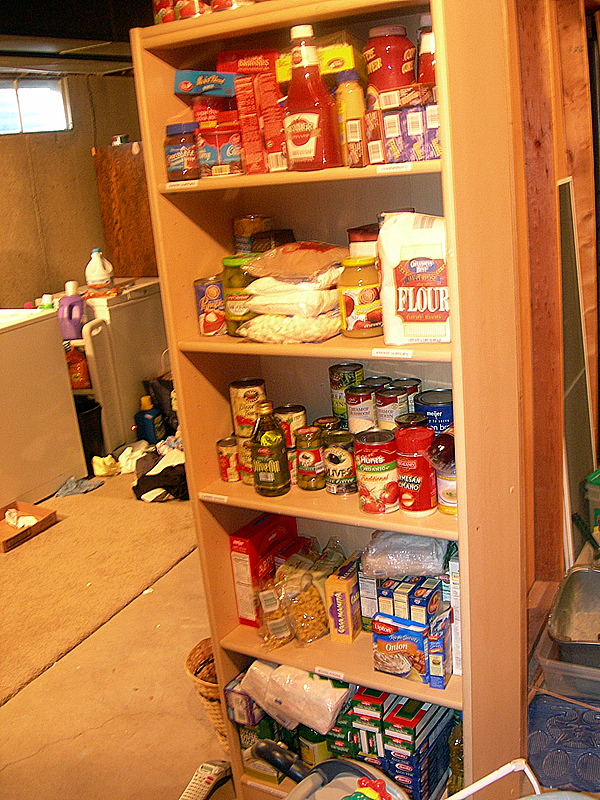 ll-lit area of our basement. The light wood color makes it easier to see what is in my pantry and the labels (created with my label maker) make it easy for even my husband to find what we need out of the pantry.
Our upstairs cupboards needed revamping as well. We have the same problem with our cupboards as we did with our former basement storage solution. One cupboard was extremely deep and items would get shoved back there until we said, “Hmmm… do you think that this is still good if it expired in 2003?” Obviously, we were wasting food and valuable cupboard space.
Repeat the same scenario above with the Lazy Susan unit that we had, but just make the items revolve in mass chaos. Clearly, we had a serious problem!
I got these handy storage baskets for less than two dollars each and divided our pantry items into categories. The storage baskets made it much easier for me to pull down exactly what I needed, rather than climbing up on a chair to try and dig through the back of the pantry. It also makes throwing items out quicker, when I need to clean out the pantry, and makes tasks easier bec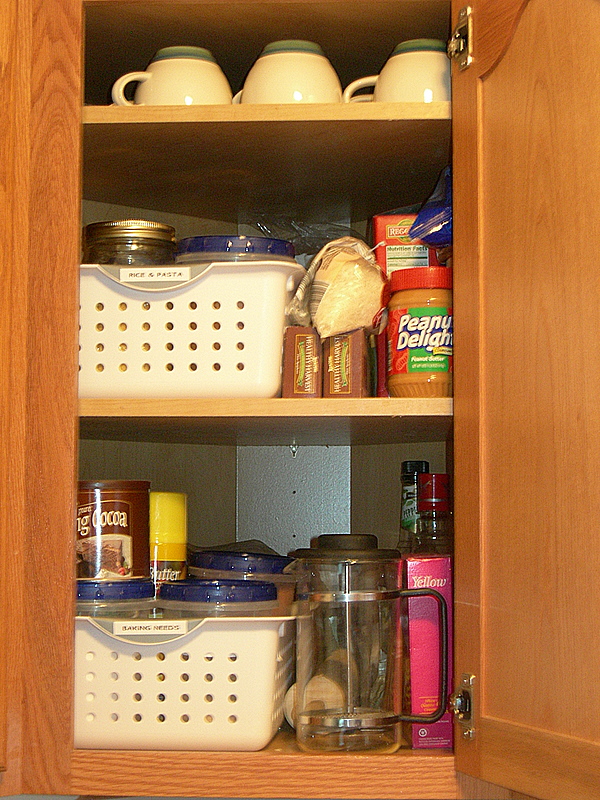 ause I had grouped like items (or cooking projects) together.
Here is how I grouped the items:
Spices- All of the spice containers were gathered together and imagine my surprise that we had plenty of repeat performers in this category. I wiped down the spices and consolidated them into one container. The spice container is residing in the cupboard closest to the stove. I can pull the small basket down and take out whatever we need and slip it back into the cupboard when I am done cooking. This is much easier than rifling through fifty teeny bottles and makes shopping day easier too!
Cake/Cookie Decorating Supplies- These are items that are used less frequently, but still needed a home. I put these higher up in a basket with handles. Piping bags, piping tips, cookie cutters, food coloring, sprinkles and the birthday candles (that no one could ever find) all went into this container.
Baking Supplies: This is a pretty general category, but it was all of the items that I needed, but could never find. In this larger basket went our baking powder, baking soda, confectioners sugar, shortening, and cocoa powder.
Rice/Pasta: These ingredients went into a larger basket and all of the boxes were consolidated and smaller pastas and the rice were placed into clear Mason jars. The mason jars were labeled and have the cooking instructions labeled on them (unless I knew the directions by heart). In the Mason jars were white rice, brown rice, jasmine rice, orzo pasta, macaroni, and couscous. Larger pasta included linguine, angel hair, and thin spaghetti. Everything fit more neatly and anything extra went into the downstairs bookcase unit.
Flour/Sugar: This organizing unit went into our Lazy Susan. This included wheat flour, white flour, self-rising flour, cake flour, brown sugar, and white sugar.
Syrups/Oi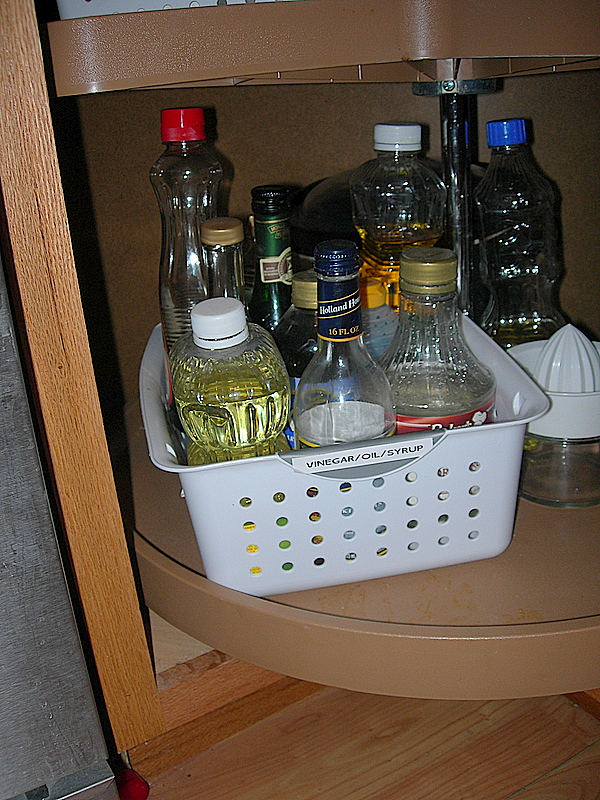 ls/Vinegars: This organizing unit also went into our Lazy Susan and included corn oil, vegetable oil, canola oil, olive oil, balsamic vinegar, white wine vinegar, red wine vinegar, molasses, honey, and maple syrup. Using this unit eliminated the “sticky” factor, which usually occurred, making a huge mess in the bottom of our pantry. Any extra condiments also get put in there, as they are often used in recipes.
Finally, the items that I like to keep on hand upstairs all go into our pantry door. We bought one of these wire units that mounts on the door and keep items that I might need on hand. A smaller unit, that clips onto the larger unit, houses all of those little packets that we might need to assemble a meal. I try to keep what we need for the week in the upstairs pantry door and then the excess (or whatever doesn’t fit) ends up going downstairs.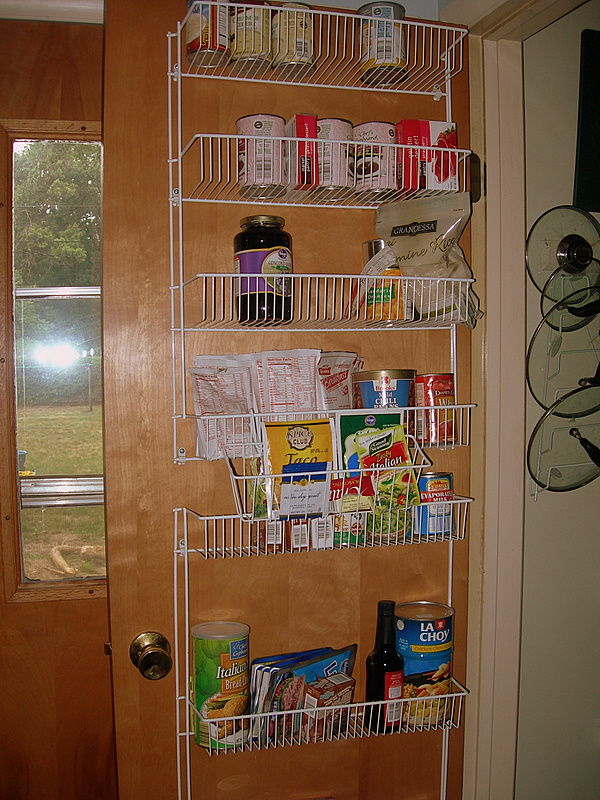
If you want, I am happy to share where we keep appliances and stuff like that, just leave me a comment!
I hope that this will help give you s
ome creative storage solutions for your pantry!
Note: You can click on the pictures to expand the size.
Related Readings:
Free Up Pantry Space & Make a Snack
Making Your Spice Rack Usable
Getting the Car Organized
Gettin’ Quick in the Kitchen
Living Out of Your Pantry
Sound Off: What storage solutions have you found work in your pantry?
 I got the opportunity to check out, “It’s All Too Much: An Easy Plan for Living a Richer Life with Less Stuff” by Peter Walsh. I was excited to read this book because I love to read up on organizing the items in my home. Unfortunately, the book focused more on the psychological aspect of people who cannot part with their clutter, rather than a book that is geared towards an enthusiastic clutter-buster.
I would highly recommend this book to someone though who is not living a life that they desire and feel consumed with the clutter in their home. He shares a lot on achieving the life that you have always wanted by taking action and parting with the “stuff” in your life that isn’t benefiting you, but is hindering you from enjoying your home and your life.
The fact is, I am the type of person that feels attached to very little in my home. It isn’t that I don’t appreciate what I have, but the desire to keep items for sentimental reasons has never been big on my priority list. I have memories of good times…not items that represent those good times.
I don’t like to collect items because I don’t like to maintain and dust collections of things. I don’t like to hang on to things that I think I might need in the future because I would rather free up the space in our home.
Don’t get me wrong, my house has true areas of chaos. Our garage is a disaster and our basement is in disarray. These are projects that I need to devote some time and thought to and seem to be the dumping stations when clutter starts to consume our house. We have definite areas that we need to work on in order to make our home more spacious and to create more organization in my life.
The one area that I have always really struggled with is my closet and the clothing in it. I hate to turn away clothing when friends and family give me things (even if I don’t look good in them) and I have hung onto my work wardrobe for no other reason than the fact that I spent a mint on it and thought I could use it when I returned to work.
The simple fact is that I have no idea when I will be returning to work and the pieces in my wardrobe are already beginning to look dated. By the time I return to work, I will still need to invest in a new wardrobe, and I will also need to get rid of the items that are taking up closet space. Why should I wait until then and just free it up now?
Since our closets are small, and the space there is so premium, I decided to use one of the tips that Peter Walsh had recommended when promoting his book on Oprah. He suggested hanging your hangers the opposite way and flipping them when you wore (not just trying on) an item. Whatever hanger did not get flipped at the end of the specified time, got the boot.
This season I was able to get rid of thirty items in my closet. I loaded them up in bags and took the stuff over to our local thrift store. Not surprisingly, this was very freeing for me and I felt really good about the small accomplishment I made.
My clothes are now sighing with relief because they can breathe a bit. Now that I have room to move my hangers and see my wardrobe, I am able to enjoy the items I have and am noticing all of the the potential outfits in my closet that I had never seen before.
Sound Off: Do you get emotionally attached to your belongings? What is your problem area in your home?
The time for cleaning and organizing is upon us as we approach that lovely time of renewal in our homes. You will notice that the stores recognize this season too, as the time for sales on expensive organizers occurs. They know that naturally as consumers, we realize that this is the season and we will run out and buy tons of storage containers, which will later gather dust in our basement and our garages. There is a cheaper alternative to organizing than just buying new items. Challenge your creativity and realize that you can organize your home in a frugal way, rather than emptying your wallet. Here are a few inexpensive alternatives:
With spring comes all of the beauty of the changing season. We finally began to see our grass; we enjoy seeing the new buds on our trees, and the sweet smell of a good April shower. What also comes along is the dreaded ritual of spring cleaning. Maybe you went through this awful experience as a child. Your mother would be pulling all the linens, washing the drapes, deep cleaning every nook and cranny of your home and then collapse after a full day of cleaning. I don’t remember this as being a fun ritual for our family and have decided to try a different method of cleaning in our own home.
Spring cleaning ironically is not as necessary as it once was. Back in the olden days, spring cleaning was a much different concept then it is today. This cleaning was a necessary routine because of how they had to heat their homes and keep them lit. Using kerosene, wood, gas, oil, and candles caused the house to develop dark sooty grime around it. This grime created the need for a deep cleaning of the home. Their deep cleaning restored the beauty of the home and also gave them the opportunity to get out the lighter linens, rugs, and furniture that they used during the warmer seasons. Not only did they divulge in spring cleaning, they also did fall cleaning as well to prepare them for the cold season of winter.
Today we do not have the need to do spring cleaning although in many families it is a ritual that brings about peace and renewal in our homes after an entire day or week of intense cleaning. In this day and age, however, it is hard to be able to set aside that much time to get all of these tasks done. Our schedules and days are so full that it hard to devote more than the few hours necessary just to keep our home running smoothly.
Instead of doing one deep cleaning I have vowed to “spring clean” all year long rather than trying to set aside a specific time to do this. With a very busy toddler and just the daily maintenance of my home, there are days when I feel really proud of myself if I can get out of my pajamas. If you are anything like me, try and incorporate these tips into your daily routine so that you can relax while everyone else is tired and haggard from their day of spring cleaning. Here are a few ideas for getting these tasks done:
It is hard to accomplish tasks around the house if you have a poor attitude about what you are doing. Unfortunately, every house requires a little maintenance and your attitude towards your work can be the difference in your spring cleaning being bearable or just plain awful. I certainly don’t jump up and down when I clean and it isn’t my favorite thing to do, but I take great pride in keeping my household running smoothly. Turn on some fun music, watch television while polishing tables, do whatever you can to make getting your home clean easier and fun.
With the arrival of your new baby, the nursery quickly becomes the most important room in the house. You will want to make sure that the nursery is organized and fully functional, helping to make the transition of a new little one in your home as easy as possible.
The planning and preparations for a new baby offers no better “dreamlike” time to showcase your creativity, let your imagination run wild and create the perfect space for your new baby, after all the nursery will be her first dwellings! Make it a special and functional room, one that will always be cherished.
Begin with a theme and allow a few months for ample planning, shopping and decorating. Choosing a character or just picking a color is a great place to start! Make sure you have the essentials (whether borrowed or purchased new), if borrowing; remember to make sure all safety standards are met. The necessities are a crib, changing table and/or dresser, rocker/glider with or without ottoman and quality lighting. When purchasing your crib sheets it is a good idea to have one or two extra sets to use when laundering the other or when baby spits-up! A “Sheet Saver” is clever quilted terrycloth “mat” that lies across and on top of your sheet under baby to catch spit-ups and drool so that you only have to wash the “Sheet Saver” and not the actual sheet. These can be purchased at major baby stores nationwide.
A good way to save some money is to convert your baby’s dresser top into a changing table by adding a changing table pad on top. The drawers of the dresser can house your diaper change necessities as well as clothing. Whether placing these items in the drawers or using baskets on a changing table you should include: diapers, wipes, diaper rash ointment, Vaseline, cotton balls, burp clothes and baby lotion or powder. A small toy helps to entertain baby while being changed!
Investing in a quality glider or rocking chair helps to ensure comfort and ample opportunities for snuggling in the wee hours of the night. If nursing, an ottoman offers a place to put your feet up and get comfortable alleviating extra strain on your back.
Extras for the nursery might include a side table, perfect next to the glider for late night-feedings. This can house a clock and lamp and glass of water (if nursing) or bottle and other feeding items. Many parents swear by an armoire which is quite functional and almost always a lovely addition to a nursery. Great for little shoes and clothing and also offers additional storage for toys blankets and books. Shelving helps to display special keepsakes, organizes books and picture frames. A music box, CD or tape player helps to soothe baby to sleep. The newest versions attach right to the side of the crib and are operated by remote control so as to not wake baby.
The single greatest nursery organizer might be the basket! Varying in all shapes, sizes and colors they offer endless storage solutions for books, blankets, toys, stuffed animals, clothing, shoes, etc. In white wicker they look especially sweet in the nursery.
Special touches such as monogrammed linens or wall hangings, murals, sterling silver keepsakes; photos and framed artwork add character and panache to a nursery.
While getting the nursery prepared do not forget to pack the diaper bag…this is a great thing to have ready to take with you to the hospital or prepared for your first trip out with your bundle of joy. Diaper bag essentials are diapers, wipes, a change (or two) of clothes, burp clothes, plastic baggies, snacks and water for you, a pacifier, small toy, cell phone and lip gloss of course! Pack the bag and hang it by the door you come and go from. Other great ways to get “organized” ahead of time is to launder the baby’s clothes, hang them or put them into drawers. Organize the bathroom essentials such as the medicine cabinet and “bath caddy”. Be sure your medicine cabinet includes rubbing alcohol, hydrogen peroxide, gas drops, a First Aid Kit, Ipecac Syrup and an infant pain reliever/fever reducer. The bath caddy should include all you need to bring “bath” to baby…baby soap and shampoo, washcloths, a small toy, warm soft towel and baby lotion!
Follow these tips and you will have a beautiful, organized nursery in plenty of time for your baby’s arrival…Wishing you lots of love and joy with your new baby in his or her beautiful new (organized) nursery!
This is the hardest place in our house to keep up with because despite the fact that we spend hours and hours in this room, it just never makes the top of the priority list. When our office is in disarray I feel as though my life is in disarray because this is where I do my work.
Now let’s say, for example, that you went to go purchase an insurance policy in an office and you walked into a tornado of paperwork laying all over the floor in piles. Would you want to purchase a policy from this office? My guess would be that you would run out and take your business elsewhere. If you have trouble finding what is underneath all the papers on your desk, it is time to make this a place that you can be proud of and one that (if you had clients) they would want to retain their business with you.
Here are a few facts that you might not be aware of. By seeing these facts, I am sickened by how much of my life has been wasted due to my disinterest in keeping our home office organized.
When I began researching this topic most of the web sites I looked to all had the same idea which was to file your papers. There are many ways you can go about doing this, but whatever your method, you want to make sure that it is simple to follow and easy to remember. Here are a few ideas for filing those piles of papers on your floor.
Just how big are these piles you are working with? You want to make sure that you have enough space in your filing cabinet to keep all of these papers. Before you think about purchasing this, you need to make a list of the things you will need in order to make your home office a more livable space. A few things that you will want to have on your list would be filing folders, a few boxes for storing things that do not need to be kept in your office, a few expandable files, and a paper shredder for shredding papers that have confidential information on them.
It is time to whittle through these enormous piles. Bring in your recycle bin and have a box ready to put papers in that need to be shredded. Read all of the papers carefully and make sure that you are not tossing anything that is of importance to you. There is no need to hang onto every single phone bill you have gotten in the past year unless you use these for tax reporting purposes. Once your next statement has arrived from the phone company and you see that they have credited your account you can toss the previous months bill.
One way of tracking your bills is to keep three separate expandable folders. I label these: Receipts, ATM withdrawals/deposits, and Paid Bills. There is no need for me to hang on to these forever, but I do keep them for a year just for my own comfort. I often need to return things and knowing that my receipts are in one particular place makes hunting for these a lot easier for me. Many professional home organizers would say that there is no need for me to hang on to these things, but if it brings me comfort and doesn’t take up too much space, then I think that this is the system that works for me.
If you have receipts that you are hanging onto because there is a warranty on the product or appliance, be sure to attach the receipt to your user manual so that you have both the manual and the receipt together if you ever need to cash in onto the warranty.
Recycle the magazines that you are hanging onto and pull out just the articles that are of importance to you. You can have a separate expandable file for these articles using the alphabetized expandable file. You can use “C” for cooking, “G” for gardening, “B” for baby and so on. By just pulling out the articles of importance you will save a lot of space in your home.
If you keep a stack of take-out menus for places you frequently eat at- designate a place for these. You can attach these with a binder clip in the front of your phone book so that they are easily accessible or if you keep a lot of these you could use a folder to keep all of them in and put them near the phone book. That should eliminate another pile.
For everything else, create folders for each grouping. If you have file folders already in your box/cabinet, take the time to go through these and weed out all of those old papers. There is no need to overload your folders with out of date information so make sure you recycle/shred all of this old information. Here are some folders that we have in our filing cabinet: Bank Statements, Taxes (be sure to put the year on the label), Medical/Dental, Utilities, Pet Information, Furniture Receipts, Appliances, Auto, Health Insurance, Life Insurance, Auto Insurance, Student Loans, Credit Cards, and User Manuals/Guides. By looking through your own piles you will know what folders you personally need to create to organize these into appropriate folders. Make sure that you do NOT have a miscellaneous folder because that is way too broad and is yet another thing you will need to weed through when trying to find a particular document. Anything worth keeping should have a home.
Once you have everything categorized and papers shredded you will be able to see just how many organizers you are going to need. By waiting until the end of your weeding you have a much clearer idea of what you need and end up spending less money. Look for attractive wicker baskets for storing current magazines, a filing cabinet/box for your papers, expandable organizers for your magazine articles/bill folders, and look for shelving to store office supplies. Use your walls to hang more shelving for books- this is wasted space for where things can be organized.
Once you have everything organized and in its respective home you need to make sure you maintain this by keeping up with the papers instead of allowing them to pile up again. When you get your mail, sort it over a recycle bin and immediately toss out the trash and junk mail so that you don’t end up spending three hours sorting through it later. Then head straight to your filing cabinet and make sure that you file the rest of the items right away. By taking these three minutes a day to do this, you will save yourself a lot of time in the end. Make a promise to yourself that you will keep up with this and reap the rewards for not wasting hours of your day looking for important documents, and then pat yourself on the back for a job well done. Cheers!
www.organizes-it.com
www.kitchensource.com
www.organize-everything.com
Home Comforts : The Art and Science of Keeping House
by Cherly Mendelson, Harry Bates
To me, this truly is the Bible for all the folk’s out there who aspire to be more organized.
Organizing from the Inside Out
by Julie Morgenstern
This woman has been featured on Oprah as a goddess for home organization. Reading her book will help you discover what type of organizer you are and how to tackle your trouble spots. Be amazed at the fantastic advice she offers.
Organizing for Dummies
by Eileen Roth and Elizabeth Miles
The title says it all. It is for those of us who are just starting on the road to organization.
Look around your kitchen and make a list of your top complaints about the room. Is the room too small? Do you not have enough counter space? Do you have trouble finding or getting to the things you need to use when you are cooking? Once you have your list in front of you it is time to begin making your dream for a better kitchen into a reality.
Here are some helpful tips to accomplish your goals:
Find a shelf that you can install somewhere near your oven or where you prepare you food so that you can find your spices quickly. If you install the spices higher then eye-level, label the spices on the front instead of the tops so that you can easily find them.
Another alternative is to purchase a container to store all of your spices in if you do not use them frequently. Place labels on the tops of the spices, alphabetize them, and store them in an easily accessible place. This will free up your counters and they will be quick to get to when you are cooking.
Designate certain shelves in your refrigerator to operate as shelves for specific items. For example, use your bottom shelf for leftovers, top shelf for beverages, put produce in its drawer, meat in its respective drawer, and door of fridge for condiments. This will make it easier when you are cooking, but it is also a great way to keep track of those leftovers. No one wants to find a forgotten leftover that has been sitting in the fridge for a month. Designate one day of the week to clean out that shelf and make sure that you rotate the leftovers with the oldest in the front and the newest in the back. Take masking tape and write the date on the top so you know when these should be tossed. It will make tracking them much easier.
Make sure that you clean the fridge periodically and I don’t mean cleaning around stuff. With either a water/vinegar solution (see my homemade cleaners section for more details) or any other all purpose cleaner really scrub the refrigerator down.
Make sure you have an opened box of baking soda in the fridge to absorb all those nasty smells that have a tendency of popping up in this appliance.
Baking Ingredients:
baking soda, baking powder, brown sugar, white sugar, flour, powdered sugar, salt, quick cooking oats, cornmeal, cooking oil (olive, canola, and vegetable), vanilla extract, spices, chocolate (semisweet chips, unsweetened and semisweet baking chocolate, cocoa powder), cream of tartar, and cooking spray
Canned Goods & Condiments:
diced tomatoes, tomato sauce, pasta sauce, whole peeled tomates, mustard, ketchup, Worchestire sauce, soy sauce, pickles, relish, and mayonnaise.
Freezer Goods:
ground beef, chicken. vegetables, noodles, bread and hamburger/hotdog buns, cheese (which can be frozen for future use), and extra flour (which can be used later as well).
For further tips on organizing your kitchen please click on the links below for more creative ideas on making your kitchen your favorite room.
www.organizes-it.com
www.kitchensource.com
www.organize-everything.com
Home Comforts : The Art and Science of Keeping House
by Cherly Mendelson, Harry Bates
To me, this truly is the Bible for all the folk’s out there who aspire to be more organized.
Organizing from the Inside Out
by Julie Morgenstern
This woman has been featured on Oprah as a goddess for home organization. Reading her book will help you discover what type of organizer you are and how to tackle your trouble spots. Be amazed at the fantastic advice she offers.
Organizing for Dummies
by Eileen Roth and Elizabeth Miles
The title says it all. It is for those of us who are just starting on the road to organization.
The living room is probably one of the places that you spend the most amount of your time. Our living room is a place for us to watch television, a place that we eat on occasion, and a playroom. I am sure that many of you make this room into a multifunctional one. With all of these uses for the room you will find how easy it is to accumulate clutter. I hope that this section will help to minimize this.
If you are in a pinch though with company on the way, have a laundry basket handy. Take all of the clutter and drop it in there, hiding this discreetly, until the guest’s leave. Don’t let this sit in a closet too long though. Once your guest’s have gone make sure that you put the belongings where they need to go. Hopefully, after reading this section, you will have nothing to even put in that laundry basket. Of course, that is wishful thinking, right?
If there are particular articles in them that you want to keep then tear them out. Take all of these articles and put them in an alphabetized expandable file. You can use “G” for gardening, “C” for cooking, and “B” for baby and so on. This will help reduce a lot of the clutter in your room. It will also make finding those special articles easier because you will know right where to look.
If you have books that you no longer read you can also trade these with a friend, put them in a box marked “garage sale”, or ask your library if they have any programs where you can donate them for the organization. If all else fails, you can always take them to a Goodwill or Salvation Army. The idea is to rid yourself of clutter, not to accumulate more, so make sure you don’t stop and look while you are dropping them off.Take a look at your counter space. If you see items on it that you do not use often, relocate them to a different area in your kitchen or basement. This will free up some very valuable countertop space.
They have lots of neat flip books that you can purchase that you could set all of the pictures in reducing the need for sixteen frames. You can also buy the small metal picture displayers that have clips to hold them where you could fan out several pictures for viewing.
Purchase a photo box and put all of your pictures in there. If you have a particular photo you would like to share, you can just get out your photo box and share them that way rather then taking up your valuable space.
Relocate them. Spread the pictures out into several rooms- use ledges, the bathroom, bedrooms, and kitchen for other areas to put them in. Many families display their picture collection in their hallway. By hanging them on the walls you reduce a lot of clutter.
Every living room is different for each person as well as what the room might function as. Try to look at your room with a friend or family member and ask them what they see in the room that needs organizing. Plan your attack based on their observations and look to books and friends for advice. The idea is to make this room livable and not a room that you dread spending time in.
www.organizes-it.com
www.kitchensource.com
www.organize-everything.com
Home Comforts : The Art and Science of Keeping House
by Cherly Mendelson, Harry Bates
To me, this truly is the Bible for all the folk’s out there who aspire to be more organized.
Organizing from the Inside Out
by Julie Morgenstern
This woman has been featured on Oprah as a goddess for home organization. Reading her book will help you discover what type of organizer you are and how to tackle your trouble spots. Be amazed at the fantastic advice she offers.
Organizing for Dummies
by Eileen Roth and Elizabeth Miles
The title says it all. It is for those of us who are just starting on the road to organization.