 Awhile ago we had a fun discussion on what you consider to be a small space and it was a great glimpse into what everyone’s space challenges were and how much space each of us were taking up. I love to see how big people’s homes are in relation to their family size and also the satisfaction that they have with the space they already have.
Just to make the story a little more fun, I had mentioned that I thought our home was 1,800 square feet because that is what my husband kept telling me. When we would flip through the home catalogs everything was in comparison of what we had (“Oh, that house is only 2,000 square feet? Well, that is only 200 square feet bigger than what we already have”).
As we were working on our office organization though, we came across some paperwork from buying our house. My husband had a shocked look on his face as he flipped through the paperwork. “Our house isn’t 1,800 square feet….it is only 1,500 square feet.” Suddenly the walls were closing in on us and we huddled together in our teeny tiny office space in our teeny tiny shack of a house and shuddered in disbelief that all this time we only had this amount of space.
Of course, that is all melodramatic and I continued to pat ourselves on the back for making this amount of space work for us. No, we have no plans for moving into a bigger space, but I just wanted to use this point to illustrate that our house is not large, nor is it small. In this area of town, our house is considered on the small end. When we lived in Massachusetts, we would have felt VERY blessed to have a home of this size. Space is all relative!
Regardless of size, I have true storage dilemmas with my home, in general, due to the tri-level floor plan of this house. The house is broken into three levels and we also have a basement (in some parts of the country it is referred to as a quad). A broken floor plan like this leaves me with zero storage space and small rooms so stockpiling can be difficult in my space. I do have a basement and a garage though so feel that I am at an advantage compared to someone who might be renting a space or live in a home without these two luxuries. And yes, I do consider having my basement and garage to be a luxury as we have lived in spaces without either of these blessings.
I am going to share some ideas for ways to store your stockpile and am opening the floor up to you to share what your storage dilemmas have been and ways you have (if you have) overcome those dilemmas in a creative way. It should be a fun discussion and I am looking forward to sharing with you!
Today we are talking about how to store your stockpiled groceries. In future discussions, I would love to share about what to do with other stockpiles you might be storing in your house (children’s clothing, toiletries, etc…), but today we will focus on the grocery aspect.
Here are some ideas for ways to store your stockpile:
– First, begin by organizing your pantry and getting rid of the items you are not using. Too often, there is space for stockpiled items, but they are being used by items that are wasting your valuable space. I have found that grouping items in totes makes it easier for me to pull out what I need when I need it, keeping the like items together and preventing items from getting lost in the shuffle. Organize the space you have to create space for all that you want to stockpile.
– One of the first places to look is at the closets that you already have in your home. While not all of us are blessed with a closet in the kitchen, some closets that are not being used can be repurposed into a more usable space. Walk around in your house and really take a look at the closets that you have and see if they are being used to the best of their ability. Try and see if there is another place for the stuff in your closet (or get rid of items that you do not use) and measure the inside of it to see how many shelves you could fit into that space. If you head over to your local hardware store, you should be able to find wired shelving that can be cut to match the size of your closet. Durable wire shelving inserted into a rarely used closet can equal an affordable solution for storing your stockpile.
– Look at the doors to your closet as a place to also store items. Hardware stores offer units that can be mounted on the door for storing your canned goods. This space is rarely used, but is an excellent place for you to store items that you are stockpiling. Likewise, the dollar stores offer over-the-door storage with plastic pocketed units that can be great for storing spices, spice packets, trail mixes, nuts, etc…
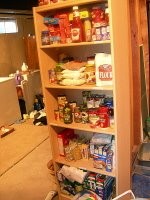
– Basements and garages are ideal spaces for stockpile storage, particularly for families who are lacking space in their kitchen itself. Try to pick a space that is easy to get to so that you can make the most of your stockpile. In a basement, for example, putting your stockpile at the bottom of the stairs so items can be grabbed easily rather than a far off or less lit corner in your basement. For a garage, storing items closest to the kitchen instead of having to walk the length of the garage would be more ideal. You can use wired shelving in these spaces, bookshelves, mount 2×4’s- whatever is cheapest and easiest for you to use.
– Under your beds can be a great storage spot for stockpiles. Although it certainly isn’t ideal, it is a more creative way to use space that is rarely used. If your bed is too low, you can purchase bed risers to raise the bed to give you more space underneath. You can purchase under-the-bed storage containers and fill these with canned goods or other items that you like to stockpile or tuck items in your rarely used suitcases or bags for a free storage solution.
– A freezer is a wise investment for anyone who is looking to stockpile their groceries. In some cases, such as rental space, a freezer might not be an option, but if it is, I have found it to be a very smart investment. If you do not think you have the space for a full-size chest freezer, Sears carries a model that is half the standard size and perfect for smaller spaces or for small families that would not need such a large freezer. We purchased this freezer for our small townhouse and we love it. Less seems to get lost in the bottom depths, but we are also able to keep it filled with stockpiled items that I have gotten from the grocery store. Consider buying one of these to help save your family money.
– In smaller spaces, it might be necessary to split your stockpiled items up in various areas around the house. A shelf in the basement, a little space in the garage, a corner in a closet, stuff under the bed…it can spell a recipe for disaster if you don’t have tight tabs on what you have stockpiled. Try keeping a list of all of the items that you have and tacking it on your refrigerator. Periodically, do an inventory of the items you have so you don’t end up repeatedly buying diced tomatoes, for example, when you already are storing forty cans. An inventory list can help decrease some of the confusion and be a great way to help you decide exactly what you will be eating in the coming weeks.
Sound Off: Where do you store your stockpiled groceries? What else would you like to see covered in our “Baby Steps” series? Help us keep this going!